We are running tours of the school until Thursday 15th October 2026.  These take place at 8.55am, 11.15am and 2.10pm.  Please call the school office on 033 336 02120 to book onto a tour.

We have staff training on Friday 16th October followed by half term so no tours will be available after 15th October 2026.

Our Sixth Form Open Evening is on Wednesday 25th November, 6pm to 7.30pm.  To register your interest and subscribe to email updates, please complete this form RGS Sixth Form Interest – Fill in form

More information will follow after the half term break.


Music

Curriculum Intent

‘Music is the universal language of mankind‘- H. Longfellow

In Music, we inspire students by studying a wide range of genres and challenge them to think, speak and act like musicians.  Music has the power to transcend differences and allow students to explore a variety of cultures whilst developing their own sense of creativity and self-confidence. We aim to develop students’ musical knowledge and skills, through a mixture of performing, analysing and composing music across the curriculum.

Music in RGS extends far beyond the timetabled lessons and takes a key place in school life.  Students have the opportunity to study a musical instrument with one of our 17 excellent peripatetic staff.  They are encouraged to join one of our five choirs (including the award winning ‘NChant’) or one of the high-quality instrumental groups, such as the RGS Symphony Orchestra or the RGS Chamber Orchestra.  We also develop students through a wide range of performance opportunities, in venues such as the Rochester Cathedral or one of our regular annual sell-out concerts. Music also plays a central role in whole school events such as Founders Day, Awards Evenings and the popular inter-house competition that is House Arts Day.
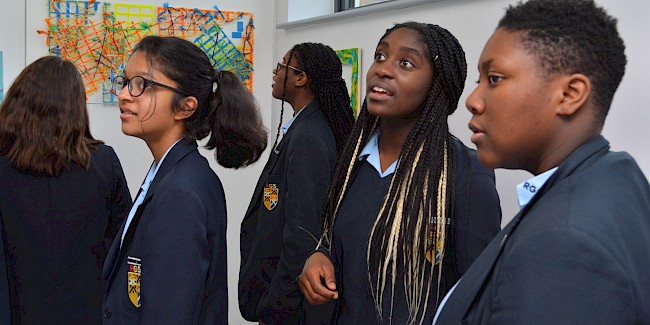

We aim to create well-rounded individuals. Music Education develops confident and committed students through developing skills and attitudes such as: problem-solving, perseverance, diligence, team work, time management, organisation, responsibility, cultural history, analysis, confidence, social skills, discipline, self-evaluation and interpersonal skills. Music students become creative and self-assured members of society with a variety of skills that allow them to succeed both musically and beyond.

Music is offered as:

  • Core subject Years 7, 8 & 9
  • GCSE Option Years 10 & 11
  • A Level Years 12 & 13

Key Stage 3 Music

Curriculum Overview

 Term 1Term 2Term 3Term 4Term 5Term 6
 Year 7What is Rhythm, Metre and Tempo?What are Rounds and How do they Work?What is a fanfare?
Year 8he Evolution of Music - from Work Songs to JazzThe Evolution of Music - from Jazz to PopDeveloping Music - Theme, Structure and Women Composers
Year 9What is the Blues and how does it structure music?How does Jazz use harmony?How can we write a pop song?How does Hip Hop represent 'The Knowledge'?

Year 7

Students receive two lessons per fortnight, through which we introduce the core elements of Music Education, which is analysis, composition and performing.  Students cultivate these skills individually, in small groups and as part of the whole class, in addition to being given a basic grounding in the key concepts of music such as melody and harmony etc.  Students are taught fundamental performance, composition and analysis skills and are introduced to Sibelius, the industry-standard music notation software. 

Year 8

Students receive three lessons per fortnight in which they expand and develop the basic skills taught in year 7 and apply them to wide variety of genres. Students are introduced to music and cultures from across the world and focus on building their knowledge and applying their skills to increasingly challenging music allowing them to increasingly develop their self-confidence and creativity. Students study a number of set works in depth. 

Year 9

Students receive two lessons per fortnight.  Students further develop the skills and knowledge gained in years 7 and 8 to provide a bridge to GCSE Music. 

Assessment

Each topic will normally entail two assessments, one practical and one analytical.  Students might be assessed on a performance or composition relating to the topic that has been studied and that will be assessed against clearly defined criteria.  Practical tasks are differentiated allowing students to be given additional credit for taking more challenging decisions.  This reflects how coursework is assessed at GCSE.

Students will also undertake regular listening and appraising assessments.  These take the form of GCSE-style listening assessments.  These assess students’ listening skills as well as their knowledge of key concepts and set works. 

Further Reading/Resources


Key Stage 4 Music

Curriculum Overview

Students at Key Stage 4 have two periods a week studying the Eduqas GCSE Music qualification

 Term 1Term 2Term 3Term 4Term 5Term 6
Year 10Melody, rhythm and tonalityTexture part 1, harmony, structure and tempoTexture part 2, Instrumentation & sonorityTechnology, dynamics, score reading, Bhangra & composition (free choice)Baroque, classical or romantic? Composing (free choice)Afro Celt Sound System - Release
Year 11Free composition and revising Bach and TotoComposing to a brief and revising AoS 1 and 2Composing to a brief and revising AoS 3 and 4Revision of course and past papersRevision 

Year 10

Students ensure their grasp of music theory and key elements is secure by starting with a core skills unit.  Students are assessed in three areas, performance, composition and analysis. Students start to study the eight set works set by the exam board in detail, including analysis of the key concepts, how it fits into the genre, and where it sits in the musical timeline.  Students also develop their performance and composition skills alongside their analysis of their set work though a mixture of practical and creative tasks which are designed to build into the two performances and two compositions submitted to the exam board in Year 11.

Year 11

Students analyse the final three set works and develop their coursework until completed.  The first of the two recorded performances takes place in September with the second taking place in January.  The first composition (set brief) is completed by December and the free composition by March with the redrafts happening in Term 4.  Once all the coursework is completed, students then have thorough revision sessions to aid them in being fully prepared for the analysis exam at the end of the two-year course.

Assessment at GCSE

  • Component 1: Performance, 30% of qualification. Students record one solo and one ensemble performance each worth 15%.  This is marked and sent to exam board for moderation. The recommended standard is at least grade 4.
  • Component 2: Composition, 30% of qualification. Students submit one free composition, which shows their creative skills in any genre for an ensemble of their choice. Students also submit a composition from a list of set briefs sent out by the exam board.  Each composition is worth 15% of the overall mark.
  • Component 3: Appraising exam, 40% of qualification. A one hour and 45 minute exam in which students answer questions on the 8 set works, an unknown piece of music, complete some dictation and then write a comparison essay between one of their set works and an unknown piece.

Further Reading/Resources

Key Stage 5 Music A Level

(Eduqas - A Level)

Curriculum Overview

Performing and Composing  - 60% 

You take either Option A or Option B: 

Option A 

Performing 35%: Total duration 10-12 minutes. Minimum of 3 pieces one of which must be a solo. Two pieces need to relate to two different areas of study.  

Composition 25%: Two compositions. One is a set brief based on the Western Classical Tradition; the other is free choice.  

Option B 

Performing 25%: Total duration of 6-8 minutes. Minimum of two pieces. One piece must reflect one area of study.  

Composing 35%: Three compositions. One is a set brief based on the Western Classical Tradition. One should be related to another area of study, and one is free choice.  

Areas of Study for performance and composition: 

  • The Western Classical Tradition (Baroque, Classical and Romantic eras) 
  • Rock and Pop 
  • Musical Theatre 
  • Jazz 
  • Into the Twentieth Century 
  • Into the Twenty First Century 

Regardless of option chosen please note that students will be expected to perform at 4 live events across the two years to help prepare for the final assessment.  

Appraising 40% 

3 areas of study: 

  1. The Western Classical Tradition, with a focus on Symphony No. 104 in D major, ‘London’ Haydn 
  2. Musical Theatre 
  3. Into the Twentieth Century, with a focus on Trio for Oboe, Bassoon and Piano, Movement II: Poulenc. 


Term 1 

Term 2 

Term 3 

Term 4 

Term 5 

Term 6 

Year 12 

History of the Symphony 


Music Theatre 


Composing Skills 


NEA preparation 

History of the Symphony 


Music Theatre 


Composing Skills 


NEA preparation 

History of the Symphony 


20th Century Music 


Composing Skills – Western Classical Tradition 


NEA preparation 


History of the Symphony 


20th Century Music 


Composing Skills – Western Classical Tradition 


NEA preparation 


History of the Symphony 


Music Theatre 


Composing Skills – Free Choice 


NEA preparation 


History of the Symphony 


20th Century Music 


Composing Skills – free choice 


NEA preparation 


Year 13 

History of the Symphony 


Music Theatre 


Composing  to a Brief 


NEA preparation 


History of the Symphony 


20th Century Music 


Composing  to a Brief 


NEA preparation 


History of the Symphony 


Music Theatre 


Composing  to a Brief 


Assessed Performance 


Finish composition NEA  


History of the Symphony 


Music Theatre 


20th Century Music 


Revision and Past Paper practice 

Exams 


Assessment

Performance: Visiting examiner between March – May in Year 13 

Composition: Externally marked 

Appraising: Written Examination of approximately 2 hours 15 minutes 

Complementary Subjects

HistoryArtDrama


British Values in Music

Rule of law: Look briefly at copyright laws as part of doing covers and theme and variations.

Individual Liberty: Elements of civil rights explored in Jazz and Blues such as Racism. Gender equality briefly explored in the fact most great composers are male (and usually white).

Mutual respect: Lots of analysis and exploration of different cultures and music including – Caribbean Music, Samba, Jazz and Blues, Indian music, British Music and African Music

Tolerance of those of different faiths and beliefs: As part of the analysis of the wide variety of worlds music (Caribbean Music, Samba, Jazz and Blues, Indian music, British Music and African Music) we explore different faiths and beliefs to promote tolerance